Shopify Development
Shopify Checkout Extensibility and WordPress Content Hubs in 2026: The Practical Ecommerce Architecture Guide
A practical news-plus-strategy guide for ecommerce brands deciding how Shopify checkout, WordPress content hubs, technical SEO, Core Web Vitals, and hybrid architecture should work together in 2026.
Shopify Checkout Extensibility and WordPress Content Hubs in 2026: The Practical Ecommerce Architecture Guide
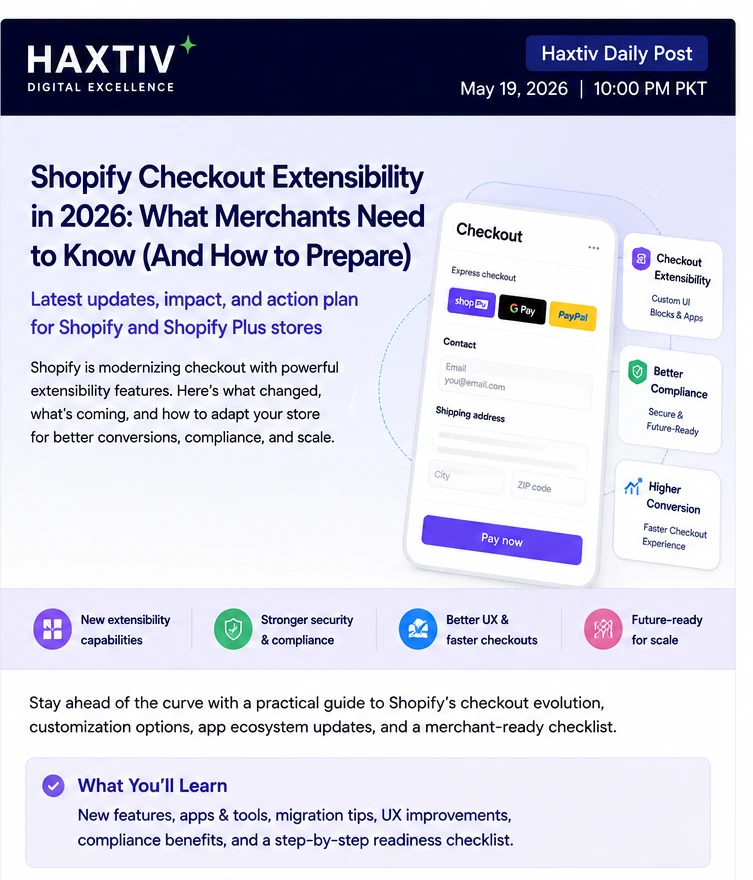
Key takeaways
- Shopify checkout is becoming more controlled, more app-driven, and more upgrade-safe. That is good for serious merchants, but it changes how customization should be planned.
- WordPress still has a clear advantage for editorial content, SEO hubs, comparison pages, guides, and industry-specific education.
- Many ecommerce brands do not need to choose between Shopify and WordPress anymore. A hybrid architecture can let Shopify own commerce while WordPress owns content.
- The wrong setup can create duplicate URLs, broken analytics, poor Core Web Vitals, weak internal links, and confusing ownership between teams.
- The right setup starts with an operating model: which platform owns products, content, checkout, SEO, analytics, forms, and campaign pages.
- This is a mixed news-plus-practical strategy guide for merchants planning redesigns, Shopify upgrades, WooCommerce migrations, or WordPress content rebuilds in 2026.
Why this is a timely ecommerce architecture question
Shopify merchants are paying closer attention to checkout architecture because the platform continues to move toward extension-based customization. That means merchants can still improve checkout, but the method is different from older, fragile patterns that relied on direct theme or checkout file edits. Shopify’s direction is more controlled, more secure, and more maintainable, but it requires better planning.
At the same time, WordPress remains the strongest open-web publishing system for many brands. It is still hard to beat WordPress when a team needs buying guides, editorial campaigns, resource centers, technical explainers, comparison pages, industry pages, and SEO-driven content operations. WordPress 6.9 also keeps pushing editing and collaboration forward, which matters for teams publishing every week.
The real question for many brands is not “Shopify or WordPress?” It is “which system should own which part of the business?”
That question matters because ecommerce teams now need to support more than a pretty storefront. They need fast pages, stable checkout, clean analytics, technical SEO, content velocity, AI-search readability, product feeds, compliant tracking, and a team workflow that does not collapse during campaigns.
Haxtiv works across Shopify development, WordPress development, technical SEO, speed optimization, and ecommerce redesigns. From that view, the best architecture is rarely the trendiest one. It is the one the team can run every week without creating hidden debt.
What Shopify Checkout Extensibility changes
Checkout Extensibility moves merchants away from brittle checkout customization and toward safer, app-based extension points. That shift matters most for Shopify Plus merchants, but the mindset affects all serious Shopify builds.
The old ecommerce habit was to modify everything directly. That created short-term flexibility and long-term risk. Custom checkout code could break during updates, slow down the purchase path, conflict with apps, or create tracking problems. In some cases, the business did not know who owned the logic because several agencies had modified the same checkout over time.
The newer model is more disciplined. Checkout changes should be made through supported extension systems, app blocks, UI extensions, Shopify Functions, branding controls, and approved app architecture. The upside is a checkout that is more upgrade-safe, easier to maintain, and less likely to become a security or performance liability.
The tradeoff is that merchants need to be clearer about what they actually want. Not every visual idea belongs inside checkout. Not every upsell is worth the friction. Not every compliance note should interrupt payment. A strong checkout strategy protects conversion first and customization second.
For growing stores, Shopify Plus development should now include checkout governance, not only feature implementation.
Why WordPress still belongs in the conversation
Shopify is excellent for commerce operations, but many brands still prefer WordPress for publishing. That is not nostalgia. It is workflow reality.
WordPress is strong when the business needs:
- long-form editorial content
- buying guides
- industry landing pages
- service explainers
- comparison content
- technical SEO control
- flexible taxonomies
- reusable content blocks
- multi-author editorial workflows
- content hubs that support search acquisition
Shopify can publish content, but its strongest center of gravity is commerce. WordPress is built around content. That distinction matters for brands where search, education, trust, and long consideration cycles drive revenue.
A content-heavy Shopify brand often reaches a point where blog posts alone are not enough. It needs structured resource centers, product education, buyer guides, SEO hubs, and industry pages. WordPress is often better for that layer, especially when the team already has editors who know the platform.
This is why hybrid setups are becoming more attractive. Shopify can handle products, checkout, orders, payments, inventory, and customer commerce operations. WordPress can handle search-driven education and brand publishing.
The architecture model: Shopify for commerce, WordPress for authority
A practical hybrid system usually assigns ownership like this.
Shopify owns:
- products
- variants
- inventory
- checkout
- payments
- discounts
- orders
- customer accounts
- fulfillment logic
- subscription or B2B commerce where relevant
WordPress owns:
- resource centers
- buying guides
- SEO landing pages
- industry pages
- comparison content
- editorial campaigns
- educational blog posts
- content-led lead capture
- authority-building pages
This setup can be powerful, but only when URL structure, analytics, tracking, performance, and internal linking are planned carefully. If Shopify and WordPress act like two unrelated websites, the user journey becomes messy. If they are treated as one system with clear roles, the result can be stronger than either platform alone.
For example, a Shopify product category may link to a WordPress buying guide. The guide may link back to relevant products, comparisons, and checkout paths. A WordPress industry page may educate a buyer, show proof, answer objections, and then send qualified traffic into Shopify. The customer experiences one brand, even though two systems are running behind it.
When this hybrid model makes sense
A Shopify + WordPress setup makes the most sense when a brand has both commerce complexity and content complexity.
It is often useful for:
- DTC brands with educational products
- B2B ecommerce companies
- technical products with long buying cycles
- premium brands with strong editorial identity
- health, beauty, fitness, finance, industrial, or professional verticals
- stores that need buying guides and comparison content
- companies moving from WooCommerce to Shopify but wanting to keep WordPress content
- brands that want strong SEO without forcing all content into Shopify
It is less useful for small stores with simple catalogs and little publishing activity. If the team publishes once every few months and sells a limited product set, a well-built Shopify theme may be enough. If the business is primarily content-led with a small checkout, WooCommerce may still be better.
This is where a discovery process matters. Platform decisions should reflect how the team works, not what the agency prefers.
The technical SEO risks
Hybrid architecture can help SEO, but it can also damage SEO if handled poorly.
Common risks include:
- duplicate content across Shopify and WordPress
- inconsistent canonical tags
- broken internal links
- poor redirect mapping during migration
- mismatched product URLs
- confusing subdomain strategy
- weak XML sitemap planning
- inconsistent structured data
- analytics sessions split across systems
- category pages competing with content pages
A good technical SEO plan should decide which URLs deserve to rank, which system owns each template, how internal links flow, how structured data is generated, and how redirects are handled. It should also define whether WordPress lives on a subfolder, subdomain, or separate domain. That decision affects SEO, analytics, deployment, and maintenance.
Haxtiv’s technical SEO services often start with exactly this kind of architecture review because SEO failures usually come from planning gaps, not only missing meta titles.
Performance planning matters before design
Performance should be discussed before visual design is approved. Both Shopify and WordPress can be fast. Both can also become slow.
Shopify performance problems often come from:
- too many apps
- heavy theme sections
- tracking scripts
- image-heavy product pages
- overloaded collection filters
- personalization tools
- review widgets
WordPress performance problems often come from:
- weak hosting
- bloated builders
- too many plugins
- poor caching
- oversized media
- heavy theme frameworks
- database clutter
A hybrid stack adds one more risk: inconsistent performance between the commerce side and the content side. If a customer moves from a fast Shopify product page to a slow WordPress buying guide, trust drops. If the WordPress content hub is fast but Shopify checkout is overloaded with scripts, conversion drops.
That is why speed work should cover both systems. Haxtiv’s website speed optimization and Shopify speed optimization work usually looks at templates, apps, hosting, media, scripts, and real-user behavior rather than one homepage score.

A practical migration checklist
If you are moving from WooCommerce to Shopify while keeping WordPress content, or restructuring a Shopify site with a new WordPress hub, use this checklist.
1. Define ownership
Decide what Shopify owns and what WordPress owns. Products, checkout, content, forms, campaigns, blog posts, customer accounts, and lead magnets need clear owners.
2. Map all URLs
Export every important URL before migration. Include product pages, categories, blog posts, landing pages, media, redirects, and old campaign URLs.
3. Decide the URL structure
Choose whether the content hub will live on a subfolder, subdomain, or separate domain. Do not make this decision casually. It affects SEO, analytics, tracking, and deployment.
4. Preserve search equity
Map redirects carefully. Keep high-value content accessible. Avoid changing every URL without need.
5. Audit structured data
Make sure Shopify product schema and WordPress article or FAQ schema do not conflict. Structured data should describe visible content accurately.
6. Align design systems
The customer should not feel like they moved between two unrelated websites. Header, footer, typography, navigation, calls to action, and brand tone should feel consistent.
7. Test analytics
Cross-domain tracking, conversion tracking, product events, lead events, and campaign attribution must be tested before launch.
8. Test performance
Run Core Web Vitals checks across both systems. Test mobile, not only desktop.
9. QA checkout and lead paths
Check product paths, cart behavior, checkout, forms, newsletter signup, lead magnets, and support paths.
10. Monitor after launch
Watch Search Console, Shopify analytics, GA4, conversion rates, crawl errors, 404s, page speed, and revenue by channel.
Checkout customization: what should actually change
Not every checkout idea improves revenue. A disciplined checkout plan should ask:
- Does this reduce uncertainty?
- Does this improve trust?
- Does this clarify shipping, returns, or payment?
- Does this reduce steps?
- Does this support compliance?
- Does this increase average order value without distracting buyers?
- Does it work cleanly on mobile?
Good checkout improvements include clear delivery messaging, better payment options, useful trust signals, simple address handling, gift options where relevant, and business-rule logic that does not slow the buyer down.
Poor checkout improvements include excessive upsells, surprise forms, confusing loyalty prompts, slow scripts, intrusive popups, and anything that makes payment feel risky.
For most brands, the checkout should be calmer, not louder.
WordPress content hubs: what should actually be published
A WordPress content hub should not become a random blog archive. It should answer buyer questions and support commercial intent.
Useful content types include:
- buying guides
- product comparison pages
- category education
- care guides
- sizing guides
- industry pages
- technical explainers
- troubleshooting pages
- migration guides
- customer education resources
A content hub works best when every article has a clear role. Some pages attract new visitors. Some help shoppers compare. Some reduce support questions. Some support paid campaigns. Some build topical authority.
For content-heavy brands, WordPress SEO agency work should connect content planning with internal links, structured data, speed, and conversion paths. SEO is not only keywords. It is architecture.
When WooCommerce remains the better choice
A hybrid Shopify + WordPress setup is not always the right answer. WooCommerce may still be the better platform when commerce is deeply tied to WordPress content, membership logic, custom workflows, or budget constraints.
WooCommerce remains strong for:
- content-led stores
- small to mid-size catalogs
- custom product logic
- member-only products
- education platforms
- publishing businesses
- service businesses with light ecommerce
- brands that want full ownership over hosting and code
The key is build quality. A clean WooCommerce build on good hosting with disciplined plugins can outperform a messy Shopify build with too many apps. Haxtiv’s WooCommerce development work focuses on that practical reality.
Budget expectations
Small scoped work can start from $500 when the task is narrow: a checkout fix, speed cleanup, landing page, redirect repair, or focused SEO update.
Most serious Shopify, WordPress, WooCommerce, or hybrid projects land between $1,000 and $5,000 when the scope is clear and the project is not a full replatform.
Larger custom builds, Shopify Plus work, headless implementations, WooCommerce migrations, and complex redesigns should be priced on demand. The risk is different. URL migration, analytics, checkout, content modeling, app integrations, and performance all affect cost.
The cheapest option is not always the least expensive. A poorly planned migration can cost more in lost traffic and conversion than the build itself.
A simple decision framework
Choose Shopify-first if checkout reliability, operational simplicity, inventory, payments, and commerce scale matter most.
Choose WordPress-first if content publishing, editorial SEO, custom workflows, and flexible content architecture matter most.
Choose hybrid if the business has serious commerce and serious content needs.
Choose headless only if the team has earned the complexity with a real business case.
That last point matters. Headless is powerful, but it creates more responsibility. Many businesses will get better results from a well-built Shopify theme, strong WordPress content hub, and careful integrations than from an overbuilt headless architecture.
Editorial conclusion
The ecommerce stack in 2026 is becoming more specialized. Shopify is strengthening its role as a commerce operating system. WordPress remains one of the best publishing and SEO systems available. Smart brands are learning to use each platform for what it does best.
That does not mean every store needs a hybrid build. It means architecture should match the business model. If checkout stability is the bottleneck, Shopify deserves serious attention. If content velocity is the bottleneck, WordPress deserves serious attention. If both are central to growth, a hybrid system may be the right answer.
The winners will not be the businesses with the most tools. They will be the businesses with clear ownership, fast templates, useful content, stable checkout, accurate analytics, and a platform strategy their team can actually run.
A good ecommerce architecture should make the business easier to operate every week. That is the standard worth building toward.
What teams should avoid
There are three mistakes Haxtiv sees repeatedly in hybrid ecommerce planning. The first is choosing a hybrid setup because it sounds sophisticated, before the team has defined who will maintain two systems. The second is rebuilding the visual design while ignoring URL structure, analytics, product data, checkout events, and migration QA. The third is treating WordPress content as a separate marketing island instead of connecting it to Shopify products, collections, and buying paths.
A good hybrid system should feel operationally calm. Editors should know where to publish. Merchants should know where products live. Developers should know which system owns templates and integrations. SEO teams should understand canonical logic. CRO teams should be able to test the journey without guessing where data comes from. When those rules are documented, the setup becomes a strength. When they are not documented, two good platforms can become one confusing system.
Before approving a build, ask for a one-page architecture map. It should show the content hub, commerce backend, checkout, analytics, forms, tracking, sitemaps, redirects, and ownership. If the map is unclear, the project is not ready for development.
Short answer for busy teams
The useful answer is not "pick the popular option" or "follow the tool your agency prefers." For website strategy, the right decision is the one that supports whether the current website system can support the next stage of growth. That means looking at the business model, the content model, the people who will operate the site, the conversion path, and the technical constraints that will still exist six months after launch.
For marketing and growth teams, the practical test is simple: will this choice improve qualified conversion rate, organic visibility, Core Web Vitals, and editor throughput, or will it only make the launch feel cleaner? Google-friendly content and AI-search-friendly content both reward the same thing here: clear answers backed by real operating judgment. A page should define the problem, explain the trade-offs, show the implementation path, and make the next decision easier for a human reader.
If you remember nothing else from this guide, remember this: do not optimize for a screenshot, a launch presentation, or a single score. Optimize for the way the website will be used every week by customers, editors, search engines, and the team responsible for keeping it accurate.
The decision framework we use in client work
When Haxtiv evaluates website strategy, we do not start with a preferred platform. We start with five questions. Each question exposes a different kind of risk, and together they usually make the right answer obvious.
1. What job must the website do for the business?
Some websites primarily create demand through education, search visibility, expert content, and trust. Others primarily convert demand that already exists through product discovery, pricing, availability, checkout, or booking. The wrong build happens when a team confuses those two jobs.
If the site has to educate buyers before they convert, the content model needs to be strong. If the site has to process product demand, the commerce or booking layer has to be stronger. If both jobs matter, the architecture needs to let each system do what it is best at instead of forcing one platform to pretend it is everything.
2. Who will operate the site after launch?
A website that only developers can improve will stall. A website that lets every editor change everything will drift. The best system gives the internal team enough control to publish quickly while protecting the design system, SEO structure, performance budget, and conversion path.
For website strategy, this is where many projects become expensive later. The launch looks fine, but the operating model is wrong. Editors avoid the CMS, developers become a bottleneck, and the marketing team creates workarounds. Within a year, the site no longer resembles the system that was approved.
3. What content needs to exist for search intent?
Search intent is not just a keyword. It is the shape of the answer a person expects. A comparison query needs trade-offs. A service query needs scope, proof, process, pricing signals, and next steps. A troubleshooting query needs symptoms, causes, order of operations, and verification.
For AI search and answer engines, the content also needs extractable structure. A strong page includes short answers, definitions, decision rules, lists, examples, FAQs, and clear internal links. That does not mean writing robotic blocks for machines. It means writing in a way that a human can scan and a machine can understand without guessing.
4. What has to be measured?
For this topic, the useful measurement set is qualified conversion rate, organic visibility, Core Web Vitals, and editor throughput. Those metrics matter because they connect the technical decision to business outcomes. A site can look better and still perform worse. A faster page can still convert poorly. A migration can preserve traffic but break lead quality. Measurement prevents the team from declaring victory too early.
We prefer before-and-after snapshots by template, not sitewide averages. Sitewide averages hide the problem. A homepage, service page, product page, blog post, location page, and checkout flow all have different jobs. Each deserves its own baseline and its own target.
5. What happens when the site changes?
The best architecture is not the one that survives launch. It is the one that survives the next campaign, the next product line, the next service page, the next redesign request, and the next algorithmic shift. This is why we care so much about content models, reusable components, schema, internal links, and performance budgets.
A website should become easier to improve over time. If every improvement requires fragile manual work, the site is not a system; it is a collection of pages.
What a useful implementation plan looks like
A good implementation plan for website strategy has four layers: discovery, architecture, production, and stabilization. Skipping any layer usually creates rework.
Discovery
Discovery should produce decisions, not a mood board. The team should leave discovery knowing the audience, the priority journeys, the content types, the URL structure, the technical constraints, the measurement plan, and the first version of the internal-link graph.
For WordPress, Shopify, and modern front-end stacks, discovery should include a crawl or platform audit when an existing site is involved. You want to know which pages currently earn impressions, which URLs have links, which templates are slow, which conversion paths work, and which parts of the CMS the team avoids.
Architecture
Architecture turns the strategy into a system. That includes page types, fields, components, navigation, taxonomy, schema, canonical logic, media policy, and editorial permissions. This is where many visually strong sites become weak: they design pages before they design the system those pages belong to.
A strong architecture also includes deletion rules. Not every old page deserves to survive. Some pages should be consolidated, redirected, rewritten, or left out of the new sitemap. The decision should be based on search demand, backlink value, conversion value, content quality, and overlap with stronger pages.
Production
Production should protect the decisions made earlier. Developers should not discover the content model halfway through the build. Designers should not invent one-off modules that the CMS cannot support. SEO should not arrive in the last week asking for headings, schema, links, and redirects.
For website strategy, production quality is visible in details: clean headings, descriptive anchor text, predictable templates, crawlable links, accessible components, image dimensions, structured data, canonical URLs, and copy that answers the query without pretending every visitor is ready to buy.
Stabilization
The first month after launch matters. Search engines recrawl. Users behave differently. Editors find rough edges. Performance data becomes real. Stabilization is where the team fixes what only live usage can reveal.
We watch index coverage, ranking movement, Core Web Vitals, conversion paths, form quality, 404 logs, internal-search terms, and editor feedback. The goal is not to panic over every movement. The goal is to notice the few issues that matter before they become expensive.
Common mistakes to avoid
The most common mistake is treating the website as a launch project instead of an operating system. It feels efficient at the time because it simplifies the decision. In practice, it moves the complexity into launch week or, worse, into the months after launch when the site is already public.
Other mistakes show up often enough that they are worth naming:
- Choosing a platform before mapping the content model.
- Treating Core Web Vitals as a final QA task instead of a build constraint.
- Letting every service, product, or location page use the same copy pattern.
- Rewriting URLs without a redirect and internal-link plan.
- Publishing comparison content that refuses to make a recommendation.
- Adding FAQ schema to weak FAQs instead of improving the actual answers.
- Measuring only traffic instead of qualified traffic, leads, revenue, and task completion.
- Letting the footer carry the internal-link strategy instead of building contextual links into the content.
The fix is not more complexity. The fix is better sequencing. Decide the job of the site, then the content model, then the platform and templates, then the migration plan, then the measurement plan. That order saves more money than almost any optimization tactic.
How this should be written for Google and AI search
Good SEO in 2026 is less about making a page longer and more about making the page complete. Length helps only when it gives the reader more useful decision support. A 4,000-word article that repeats itself is worse than a 1,200-word article that solves the problem. But for complex commercial and technical topics, thin content usually fails because the real answer needs nuance.
For website strategy, a strong page should include:
- A direct answer near the top.
- A clear definition of the problem.
- The situations where each option is best.
- The situations where each option is risky.
- Specific implementation steps.
- A measurement plan.
- Mistakes to avoid.
- FAQs that answer real objections.
- Links to deeper service or resource pages.
This structure helps traditional search because it covers intent thoroughly. It helps AI systems because the page contains concise, quotable answers and clear relationships between entities, actions, risks, and outcomes. Most importantly, it helps humans because it respects their time.
Measurement plan after the decision
Do not wait until the project is finished to define success. For website strategy, we would track qualified conversion rate, organic visibility, Core Web Vitals, and editor throughput. We would also separate leading indicators from lagging indicators.
Leading indicators appear quickly: crawl health, indexability, LCP, INP, CLS, form errors, editor publishing speed, and content completion. Lagging indicators take longer: rankings, organic revenue, lead quality, assisted conversions, retention, and total cost of ownership.
A simple dashboard is enough. Track the metrics by template and by journey. If the homepage improved but service pages declined, the average does not matter. If traffic increased but qualified leads fell, the project did not succeed. If performance improved in Lighthouse but real-user CrUX data stayed poor, the work is not finished.
Quality-control checklist before you publish or launch
Before publishing a page, launching a redesign, or committing to a platform decision, run a final quality-control pass. This is where good teams catch the issues that do not show up in a design review.
First, read the page as a buyer would. Does it answer the main question quickly? Does it explain who the advice is for? Does it say when the recommendation is not the right fit? Helpful content is not afraid to disqualify. If every option sounds equally good, the page is not helping.
Second, read the page as an editor would. Are the headings predictable? Are examples concrete? Are internal links placed where the reader naturally needs the next step? Are important claims supported by process, data, examples, or experience? This is the difference between expert content and decorative content.
Third, read the page as a crawler would. Is there one clear H1? Do H2s describe the actual sections? Are links crawlable? Is schema aligned with visible content? Is the canonical URL correct? Are images sized, described, and useful? Are FAQs genuinely visible on the page rather than added only for structured data?
Finally, read the page as an operator would. Can the team maintain this system next quarter? Can they add another service, product, location, or article without breaking design quality? Can they measure whether the work performed? If the answer is no, the issue is not content length; it is architecture.
Practical next step
If you are making this decision now, write down the constraint first. Is the constraint search visibility, speed, editor control, checkout conversion, compliance, migration risk, design quality, or maintenance cost? Once the constraint is named, the right path is easier to see.
For a second opinion, start with our website strategy and development work. If the decision is connected to a broader website project, also read our process. We can usually tell within one call whether the project needs a focused fix, a redesign, a rebuild, or a smaller scope than expected.
FAQs about website strategy
What is the short answer on website strategy?
The short answer is to make the decision around whether the current website system can support the next stage of growth. The right choice is the one that improves qualified conversion rate, organic visibility, Core Web Vitals, and editor throughput, not the one that sounds best in a tool comparison.
Who should care most about website strategy?
marketing and growth teams should care because this decision affects search visibility, conversion quality, operating cost, and how easily the website can improve after launch.
What is the biggest mistake with website strategy?
The biggest mistake is treating the website as a launch project instead of an operating system. Strong teams validate the decision against user intent, platform constraints, measurement, and the people who will maintain the site.
How should teams measure whether website strategy worked?
Measure qualified conversion rate, organic visibility, Core Web Vitals, and editor throughput. Do not rely on launch-day opinions or lab-only scores; use real user behavior, search data, and conversion outcomes.
Final recommendation
Do the smallest serious version of the work. Not the cheapest version. Not the biggest version. The smallest serious version is the scope that solves the real constraint, protects the site from avoidable search and performance risk, and gives the team a system they can keep improving.
That is the standard we use for Shopify Development, Shopify, Checkout Extensibility, WordPress, Content Hubs, Technical SEO, Core Web Vitals, WooCommerce, Shopify Plus, Hybrid Ecommerce, CRO. If the work does not make the site clearer for users, easier for editors, healthier for search engines, and more measurable for the business, it is probably not the right work yet.
Shopify vs WordPress vs Hybrid Ecommerce Architecture
| Decision factor | Shopify-first | WordPress-first | Hybrid Shopify + WordPress |
|---|---|---|---|
| Checkout reliability | Strongest | Depends on WooCommerce setup | Strongest when Shopify owns checkout |
| Editorial SEO | Moderate | Strongest | Strongest when WordPress owns content |
| Maintenance | Lower | Depends on plugins and hosting | Moderate with good governance |
| Content velocity | Moderate | High | High |
| Commerce scale | High | Medium to high with strong build | High |
| Best fit | Commerce-led brands | Content-led brands | Brands with serious commerce and serious content needs |
Frequently Asked Questions
What is Shopify Checkout Extensibility?
Why would a Shopify brand still use WordPress?
Is a Shopify and WordPress hybrid setup good for SEO?
Should WooCommerce stores migrate to Shopify?
Do all ecommerce brands need headless commerce?
What should be tested during a hybrid migration?
How much does this kind of work cost?
Who should own the content hub after launch?
James Holloway
More about the studio →