Shopify Development
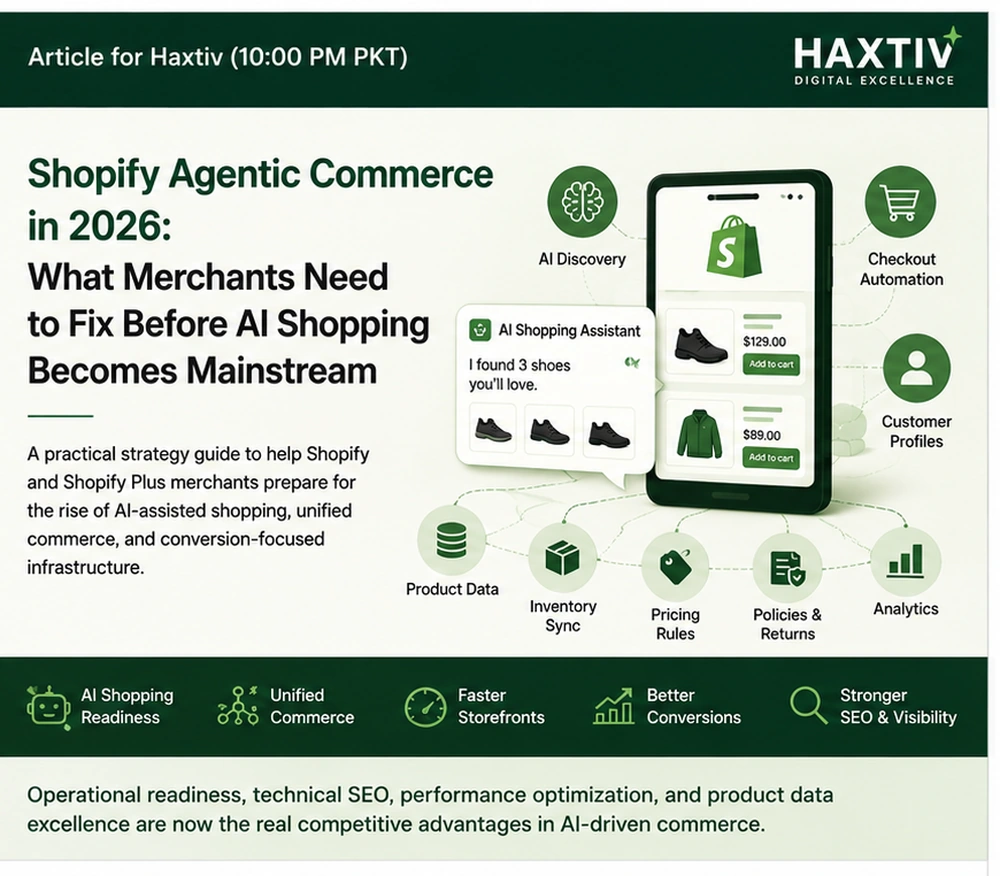
Shopify Agentic Commerce in 2026: What Merchants Need to Fix Before AI Shopping Becomes Mainstream
A practical news-plus-action guide for Shopify and Shopify Plus merchants preparing product data, storefront speed, schema, apps, policies, and checkout operations for AI-assisted shopping.
Shopify Agentic Commerce in 2026: What Merchants Need to Fix Before AI Shopping Becomes Mainstream

Key takeaways
- Agentic commerce is becoming practical ecommerce infrastructure, not only AI marketing noise.
- Shopify and Shopify Plus merchants should prepare by cleaning product data, improving storefront performance, simplifying apps, strengthening collection pages, clarifying policies, and validating schema.
- Most merchants do not need a full rebuild today. They need an operational readiness sprint.
- The biggest risk is not missing one AI tool. The bigger risk is running a messy store that customers and machines both struggle to understand.
- The same work improves SEO, Core Web Vitals, conversion rate, merchandising, customer support, and paid traffic efficiency.
- This is a mixed news-plus-action guide for Shopify, WooCommerce, WordPress, and content-led ecommerce teams.
Why this matters now
The ecommerce industry has spent years talking about AI-generated copy, chatbots, recommendation engines, and personalization. Those tools still matter, but the more important shift is agentic commerce: AI systems that can help shoppers evaluate options, compare products, build carts, apply context, and move closer to checkout.
Recent coverage around Shopify, Google, Gemini, Microsoft Copilot, PayPal, Universal Commerce Protocol, and AI shopping points in the same direction. AI-assisted commerce is moving closer to the transaction. Merchants do not control that whole ecosystem, but they do control the quality of the store data and storefront experience those systems rely on.
The question for merchants is simple: if an AI shopping assistant reads your store, will it understand what you sell, who each product is for, what variants mean, how shipping works, what returns allow, what customers say, and why the shopper should trust you?
If the store has inconsistent titles, weak variants, slow templates, duplicate apps, unclear policies, missing schema, and thin product pages, AI shopping will not fix that. It will expose it.
That is why Haxtiv treats AI commerce readiness as an operational audit. The work sits across <a href="https://haxtiv.com/services/shopify-development">Shopify development</a>, <a href="https://haxtiv.com/services/shopify-seo">Shopify SEO</a>, <a href="https://haxtiv.com/services/shopify-speed-optimization">Shopify speed optimization</a>, <a href="https://haxtiv.com/conversion-rate-optimization">conversion rate optimization</a>, and technical SEO.
What agentic commerce means in plain English
Agentic commerce means AI systems can perform meaningful shopping tasks for users. They may compare products, read reviews, filter compatible options, summarize policies, recommend bundles, track prices, apply delivery constraints, and guide the user toward purchase.
This does not mean every store needs a science-fiction checkout. It means ecommerce systems need to become more legible. AI systems need structured product information, reliable inventory signals, clear policies, usable schema, and predictable checkout behavior. Human shoppers need the same things.
A customer might tolerate friction by messaging support. An AI shopping assistant has less patience for contradictions. If one page says delivery is three days and another says seven, if one variant says green and another says olive for the same color, or if schema conflicts with visible product data, the store becomes less trustworthy.
The hidden problem: stores grow faster than systems
Most Shopify stores do not start messy. They become messy.
A typical growth path looks like this: launch a theme, add reviews, add email, add SMS, add subscriptions, add upsells, add popup tools, add loyalty, add analytics, add new markets, add product bundles, add personalization, add landing pages, add a quiz, add more tracking.
Each decision may be reasonable. The cumulative result is often not.
Eventually the store has overlapping tools, unclear ownership, and frontend cost nobody can explain. That affects performance, conversion, SEO, analytics, and customer support. Agentic commerce simply raises the cost of ignoring it.
Step 1: clean product data before redesigning
Most merchants want to start with design. Start with the catalog.
Export products and review product names, product types, collections, variants, metafields, tags, media, alt text, prices, inventory, dimensions, materials, compatibility, subscription options, bundle logic, shipping restrictions, and return rules.
Look for inconsistent naming, unclear variants, duplicate tags, empty metafields, weak descriptions, missing dimensions, thin images, and mismatched policy information. A clean catalog improves site search, filters, collection pages, paid feeds, SEO, AI discovery, and internal operations.
This work is not glamorous, but it creates leverage. A redesigned store with messy product data still leaks revenue.
Step 2: make collection pages useful
Collection pages are often thin product grids. That is a missed opportunity.
A strong collection page should explain buying intent. A shopper browsing running shoes, office furniture, skincare, cookware, safety equipment, or B2B supplies needs a way to choose. Add short editorial context, useful filters, decision criteria, links to relevant guides, and FAQs where appropriate.
Do not bury products under long copy. The goal is to make the page easier to use. A good collection page helps customers, search systems, and AI assistants understand the category.
For stores investing in visual merchandising, Haxtiv’s <a href="https://haxtiv.com/services/shopify-store-design">Shopify store design</a> work often focuses on the link between merchandising clarity and conversion behavior.
Step 3: audit the app stack
Apps are useful. Unmanaged apps are expensive.
Create an app register with app name, owner, purpose, pages affected, scripts loaded, data created, monthly cost, business value, performance impact, replacement options, and removal risk.
Then classify each app as keep, replace, consolidate, remove, or rebuild as custom functionality. Pay attention to apps that control reviews, subscriptions, bundles, product options, analytics, schema, personalization, checkout-adjacent behavior, or customer data.
The goal is not to remove apps blindly. The goal is to stop paying performance and maintenance tax for tools that no longer earn their place. Haxtiv’s <a href="https://haxtiv.com/services/shopify-app-integrations">Shopify app integrations</a> work treats apps as part of system architecture, not decoration.
Step 4: improve Core Web Vitals where revenue happens
AI commerce does not reduce the importance of speed. It increases it.
Fast pages are easier to crawl, easier to interpret, and easier to buy from. For Shopify stores, the usual offenders are oversized hero media, too many app scripts, delayed review widgets, unstable banners, product media galleries, tracking pixels, and heavy personalization tools.
Measure templates, not only the homepage. Review product pages, collection pages, cart, checkout-adjacent pages, landing pages, buying guides, and blog posts. Fix repeated template problems first because they compound across the store.
Haxtiv’s <a href="https://haxtiv.com/website-speed-optimization">website speed optimization</a> and Shopify speed work usually starts with template-level impact.
Step 5: clarify policies
Shipping, returns, warranty, subscription cancellation, delivery limits, final-sale rules, and support response times affect conversion. They also affect AI-generated product summaries and recommendations.
Review every policy page. Remove contradictions. Add short policy summaries to product pages and cart pages where they matter. Keep the full policy available, but do not make customers hunt for the answer.
Step 6: clean schema without plugin chaos
Structured data helps search and AI systems understand products, offers, breadcrumbs, reviews, FAQs, and articles. But schema should describe visible truth.
Check whether the theme, SEO app, review app, and custom code output overlapping schema. Duplicate or contradictory schema can hurt trust. Haxtiv’s <a href="https://haxtiv.com/technical-seo-services">technical SEO services</a> often find that the problem is not missing schema. It is conflicting schema.
Step 7: add editorial proof
AI shopping systems may summarize products, but they still need evidence. Customers need it too.
Add useful content around products: buying guides, care guides, sizing guides, compatibility notes, comparison pages, material explainers, gift guides, industry pages, and FAQs. For Shopify, this supports merchandising. For WooCommerce and WordPress, content depth can be a major advantage.
Haxtiv’s <a href="https://haxtiv.com/blog/wordpress-vs-shopify-2026">WordPress vs Shopify guide</a> explains why the best platform choice depends on what the team needs to ship every week.
Step 8: decide if headless is earned
Headless can be useful, but it is not automatically better.
It may make sense for large catalogs, advanced editorial-commerce blending, Shopify Plus scale, multi-region storefronts, custom discovery, shared design systems, or complex personalization. It may not make sense for small stores with simple requirements.
A well-optimized Shopify theme can beat a poorly maintained headless storefront. Haxtiv’s <a href="https://haxtiv.com/services/shopify-plus-development">Shopify Plus development</a> and <a href="https://haxtiv.com/services/headless-wordpress-development">headless WordPress development</a> work starts with the same question: what complexity has the business actually earned?
A 30-day readiness sprint
Week 1: data and app audit
Export product data, collect app information, check schema, review analytics, and map the main templates.
Week 2: content and collection cleanup
Improve top product and collection pages. Add decision support, FAQs, policy summaries, and internal links.
Week 3: speed and app rationalization
Remove or defer weak scripts, optimize media, simplify template load, and fix mobile performance issues.
Week 4: schema, analytics, and conversion QA
Validate schema, test checkout paths, review cart behavior, update channel groupings, and document operating rules.
Budget expectations
Small scoped improvements can start from $500 when the issue is narrow. Many Shopify, WooCommerce, or WordPress optimization projects land between $1,000 and $5,000. Larger Shopify Plus, headless, migration, or custom ecommerce builds should be priced on demand because integrations, data, checkout, SEO, and risk vary widely.
Buy the right scope. Do not buy a rebuild when a readiness sprint would solve the bottleneck. Do not keep patching a fragile store when the foundation needs rebuilding.
Editorial conclusion
AI shopping does not change the fundamentals of good ecommerce. It raises the penalty for ignoring them.
The stores that win will be easier to understand. Their product data will be cleaner. Their collection pages will help customers choose. Their templates will be faster. Their policies will be clearer. Their app stacks will be calmer. Their checkout paths will be easier to trust.
That is the work.
For Shopify merchants, this is the right moment to run an operational readiness sprint before AI-assisted shopping becomes normal customer behavior.
Additional operating note
AI commerce readiness should become an ongoing operating rhythm, not a one-time campaign. Each new product launch should follow the same rules: clean title, correct variant structure, complete metafields, useful media, clear policy notes, schema validation, speed review, and analytics QA. This discipline compounds over time.
Additional operating note
AI commerce readiness should become an ongoing operating rhythm, not a one-time campaign. Each new product launch should follow the same rules: clean title, correct variant structure, complete metafields, useful media, clear policy notes, schema validation, speed review, and analytics QA. This discipline compounds over time.
Additional operating note
AI commerce readiness should become an ongoing operating rhythm, not a one-time campaign. Each new product launch should follow the same rules: clean title, correct variant structure, complete metafields, useful media, clear policy notes, schema validation, speed review, and analytics QA. This discipline compounds over time.
Additional operating note
AI commerce readiness should become an ongoing operating rhythm, not a one-time campaign. Each new product launch should follow the same rules: clean title, correct variant structure, complete metafields, useful media, clear policy notes, schema validation, speed review, and analytics QA. This discipline compounds over time.
What to document after the sprint
A readiness sprint should end with operating rules, not only completed tasks. Document how products should be named, which metafields are required, which apps own which data, which product-page sections are mandatory, how collection intros are written, how policy snippets are maintained, and which performance checks run before a campaign launches.
This documentation is especially useful for teams that publish often. A Shopify team adding new products every week needs rules that are easy to follow. A content-led WooCommerce team needs repeatable product and category patterns. An agency or white-label partner needs enough documentation to keep future work consistent.
What not to do
Do not install an AI commerce app before fixing the store’s product architecture. Do not move headless because a competitor did. Do not rewrite every collection page with generic AI copy. Do not add schema that does not match visible content. Do not remove useful apps only to replace them with worse custom code. Do not optimize only the homepage when revenue comes from product and collection templates.
The practical move is to work from revenue risk. Which pages produce sales? Which products create support tickets? Which templates are slow? Which apps affect checkout? Which policies cause hesitation? Those answers should guide the roadmap.
Why this is different from a redesign
A redesign changes presentation. An agentic-commerce readiness project changes the operating system behind the storefront. It cleans the data layer, content layer, performance layer, analytics layer, and policy layer. The visual design may improve as part of the work, but design is not the only goal.
The best outcome is a store the team can operate calmly. Products launch with complete data. Collection pages explain buying intent. Apps have owners. Schema validates. Core Web Vitals stay within range. Checkout is tested. Analytics tell the truth. That kind of discipline is less glamorous than a new homepage, but it usually creates more durable revenue.
How Haxtiv would scope the first call
The first discovery call should not start with a theme preference. It should start with store symptoms: traffic, conversion rate, mobile revenue, top categories, app count, Core Web Vitals, SEO trend, support complaints, and operational bottlenecks. From there, the right scope becomes clearer.
Sometimes the answer is a small speed cleanup. Sometimes it is product data governance. Sometimes it is Shopify Plus work. Sometimes it is a migration, a headless build, or a CRO sprint. The point is to diagnose before prescribing.
What a merchant should not automate yet
Some ecommerce work should stay under human control until the store is cleaner. Do not let AI systems rewrite product claims without compliance review. Do not automate discount logic if your pricing rules are already inconsistent. Do not push AI-generated collection copy live without checking accuracy, tone, and search intent. Do not let a recommendation system create bundles that break inventory, shipping, or margin assumptions.
Start with assisted workflows. Let AI help draft product descriptions, summarize reviews, identify missing metafields, cluster customer questions, or flag inconsistent policy language. Keep approval with the merchandising, SEO, or operations owner. Once the operating rules are stable, automation can expand safely.
The weekly operating rhythm
After the first readiness sprint, make this a weekly rhythm. Every new product should be checked for title quality, variant structure, metafields, product media, alt text, collection assignment, policy notes, schema output, and analytics events. Every new app should have an owner, a purpose, a cost, and a performance review. Every new landing page should be tested on mobile before traffic is sent to it.
This is not busywork. It is how a store avoids becoming fragile again six months after cleanup. Agentic commerce rewards stores that stay understandable over time, not stores that run one audit and forget the rules.
Final operating reminder
The store does not need to look complicated to be ready. It needs to be consistent. A clean Shopify build with complete products, fast pages, honest policies, tested checkout, and maintained apps will beat a flashy store with unclear data. That is the difference between a site that merely looks current and a store that is ready for how ecommerce is actually changing.
Short answer for busy teams
The useful answer is not "pick the popular option" or "follow the tool your agency prefers." For website strategy, the right decision is the one that supports whether the current website system can support the next stage of growth. That means looking at the business model, the content model, the people who will operate the site, the conversion path, and the technical constraints that will still exist six months after launch.
For marketing and growth teams, the practical test is simple: will this choice improve qualified conversion rate, organic visibility, Core Web Vitals, and editor throughput, or will it only make the launch feel cleaner? Google-friendly content and AI-search-friendly content both reward the same thing here: clear answers backed by real operating judgment. A page should define the problem, explain the trade-offs, show the implementation path, and make the next decision easier for a human reader.
If you remember nothing else from this guide, remember this: do not optimize for a screenshot, a launch presentation, or a single score. Optimize for the way the website will be used every week by customers, editors, search engines, and the team responsible for keeping it accurate.
The decision framework we use in client work
When Haxtiv evaluates website strategy, we do not start with a preferred platform. We start with five questions. Each question exposes a different kind of risk, and together they usually make the right answer obvious.
1. What job must the website do for the business?
Some websites primarily create demand through education, search visibility, expert content, and trust. Others primarily convert demand that already exists through product discovery, pricing, availability, checkout, or booking. The wrong build happens when a team confuses those two jobs.
If the site has to educate buyers before they convert, the content model needs to be strong. If the site has to process product demand, the commerce or booking layer has to be stronger. If both jobs matter, the architecture needs to let each system do what it is best at instead of forcing one platform to pretend it is everything.
2. Who will operate the site after launch?
A website that only developers can improve will stall. A website that lets every editor change everything will drift. The best system gives the internal team enough control to publish quickly while protecting the design system, SEO structure, performance budget, and conversion path.
For website strategy, this is where many projects become expensive later. The launch looks fine, but the operating model is wrong. Editors avoid the CMS, developers become a bottleneck, and the marketing team creates workarounds. Within a year, the site no longer resembles the system that was approved.
3. What content needs to exist for search intent?
Search intent is not just a keyword. It is the shape of the answer a person expects. A comparison query needs trade-offs. A service query needs scope, proof, process, pricing signals, and next steps. A troubleshooting query needs symptoms, causes, order of operations, and verification.
For AI search and answer engines, the content also needs extractable structure. A strong page includes short answers, definitions, decision rules, lists, examples, FAQs, and clear internal links. That does not mean writing robotic blocks for machines. It means writing in a way that a human can scan and a machine can understand without guessing.
4. What has to be measured?
For this topic, the useful measurement set is qualified conversion rate, organic visibility, Core Web Vitals, and editor throughput. Those metrics matter because they connect the technical decision to business outcomes. A site can look better and still perform worse. A faster page can still convert poorly. A migration can preserve traffic but break lead quality. Measurement prevents the team from declaring victory too early.
We prefer before-and-after snapshots by template, not sitewide averages. Sitewide averages hide the problem. A homepage, service page, product page, blog post, location page, and checkout flow all have different jobs. Each deserves its own baseline and its own target.
5. What happens when the site changes?
The best architecture is not the one that survives launch. It is the one that survives the next campaign, the next product line, the next service page, the next redesign request, and the next algorithmic shift. This is why we care so much about content models, reusable components, schema, internal links, and performance budgets.
A website should become easier to improve over time. If every improvement requires fragile manual work, the site is not a system; it is a collection of pages.
What a useful implementation plan looks like
A good implementation plan for website strategy has four layers: discovery, architecture, production, and stabilization. Skipping any layer usually creates rework.
Discovery
Discovery should produce decisions, not a mood board. The team should leave discovery knowing the audience, the priority journeys, the content types, the URL structure, the technical constraints, the measurement plan, and the first version of the internal-link graph.
For WordPress, Shopify, and modern front-end stacks, discovery should include a crawl or platform audit when an existing site is involved. You want to know which pages currently earn impressions, which URLs have links, which templates are slow, which conversion paths work, and which parts of the CMS the team avoids.
Architecture
Architecture turns the strategy into a system. That includes page types, fields, components, navigation, taxonomy, schema, canonical logic, media policy, and editorial permissions. This is where many visually strong sites become weak: they design pages before they design the system those pages belong to.
A strong architecture also includes deletion rules. Not every old page deserves to survive. Some pages should be consolidated, redirected, rewritten, or left out of the new sitemap. The decision should be based on search demand, backlink value, conversion value, content quality, and overlap with stronger pages.
Production
Production should protect the decisions made earlier. Developers should not discover the content model halfway through the build. Designers should not invent one-off modules that the CMS cannot support. SEO should not arrive in the last week asking for headings, schema, links, and redirects.
For website strategy, production quality is visible in details: clean headings, descriptive anchor text, predictable templates, crawlable links, accessible components, image dimensions, structured data, canonical URLs, and copy that answers the query without pretending every visitor is ready to buy.
Stabilization
The first month after launch matters. Search engines recrawl. Users behave differently. Editors find rough edges. Performance data becomes real. Stabilization is where the team fixes what only live usage can reveal.
We watch index coverage, ranking movement, Core Web Vitals, conversion paths, form quality, 404 logs, internal-search terms, and editor feedback. The goal is not to panic over every movement. The goal is to notice the few issues that matter before they become expensive.
Common mistakes to avoid
The most common mistake is treating the website as a launch project instead of an operating system. It feels efficient at the time because it simplifies the decision. In practice, it moves the complexity into launch week or, worse, into the months after launch when the site is already public.
Other mistakes show up often enough that they are worth naming:
- Choosing a platform before mapping the content model.
- Treating Core Web Vitals as a final QA task instead of a build constraint.
- Letting every service, product, or location page use the same copy pattern.
- Rewriting URLs without a redirect and internal-link plan.
- Publishing comparison content that refuses to make a recommendation.
- Adding FAQ schema to weak FAQs instead of improving the actual answers.
- Measuring only traffic instead of qualified traffic, leads, revenue, and task completion.
- Letting the footer carry the internal-link strategy instead of building contextual links into the content.
The fix is not more complexity. The fix is better sequencing. Decide the job of the site, then the content model, then the platform and templates, then the migration plan, then the measurement plan. That order saves more money than almost any optimization tactic.
How this should be written for Google and AI search
Good SEO in 2026 is less about making a page longer and more about making the page complete. Length helps only when it gives the reader more useful decision support. A 4,000-word article that repeats itself is worse than a 1,200-word article that solves the problem. But for complex commercial and technical topics, thin content usually fails because the real answer needs nuance.
For website strategy, a strong page should include:
- A direct answer near the top.
- A clear definition of the problem.
- The situations where each option is best.
- The situations where each option is risky.
- Specific implementation steps.
- A measurement plan.
- Mistakes to avoid.
- FAQs that answer real objections.
- Links to deeper service or resource pages.
This structure helps traditional search because it covers intent thoroughly. It helps AI systems because the page contains concise, quotable answers and clear relationships between entities, actions, risks, and outcomes. Most importantly, it helps humans because it respects their time.
Measurement plan after the decision
Do not wait until the project is finished to define success. For website strategy, we would track qualified conversion rate, organic visibility, Core Web Vitals, and editor throughput. We would also separate leading indicators from lagging indicators.
Leading indicators appear quickly: crawl health, indexability, LCP, INP, CLS, form errors, editor publishing speed, and content completion. Lagging indicators take longer: rankings, organic revenue, lead quality, assisted conversions, retention, and total cost of ownership.
A simple dashboard is enough. Track the metrics by template and by journey. If the homepage improved but service pages declined, the average does not matter. If traffic increased but qualified leads fell, the project did not succeed. If performance improved in Lighthouse but real-user CrUX data stayed poor, the work is not finished.
Quality-control checklist before you publish or launch
Before publishing a page, launching a redesign, or committing to a platform decision, run a final quality-control pass. This is where good teams catch the issues that do not show up in a design review.
First, read the page as a buyer would. Does it answer the main question quickly? Does it explain who the advice is for? Does it say when the recommendation is not the right fit? Helpful content is not afraid to disqualify. If every option sounds equally good, the page is not helping.
Second, read the page as an editor would. Are the headings predictable? Are examples concrete? Are internal links placed where the reader naturally needs the next step? Are important claims supported by process, data, examples, or experience? This is the difference between expert content and decorative content.
Third, read the page as a crawler would. Is there one clear H1? Do H2s describe the actual sections? Are links crawlable? Is schema aligned with visible content? Is the canonical URL correct? Are images sized, described, and useful? Are FAQs genuinely visible on the page rather than added only for structured data?
Finally, read the page as an operator would. Can the team maintain this system next quarter? Can they add another service, product, location, or article without breaking design quality? Can they measure whether the work performed? If the answer is no, the issue is not content length; it is architecture.
Practical next step
If you are making this decision now, write down the constraint first. Is the constraint search visibility, speed, editor control, checkout conversion, compliance, migration risk, design quality, or maintenance cost? Once the constraint is named, the right path is easier to see.
For a second opinion, start with our website strategy and development work. If the decision is connected to a broader website project, also read our process. We can usually tell within one call whether the project needs a focused fix, a redesign, a rebuild, or a smaller scope than expected.
FAQs about website strategy
What is the short answer on website strategy?
The short answer is to make the decision around whether the current website system can support the next stage of growth. The right choice is the one that improves qualified conversion rate, organic visibility, Core Web Vitals, and editor throughput, not the one that sounds best in a tool comparison.
Who should care most about website strategy?
marketing and growth teams should care because this decision affects search visibility, conversion quality, operating cost, and how easily the website can improve after launch.
What is the biggest mistake with website strategy?
The biggest mistake is treating the website as a launch project instead of an operating system. Strong teams validate the decision against user intent, platform constraints, measurement, and the people who will maintain the site.
How should teams measure whether website strategy worked?
Measure qualified conversion rate, organic visibility, Core Web Vitals, and editor throughput. Do not rely on launch-day opinions or lab-only scores; use real user behavior, search data, and conversion outcomes.
Final recommendation
Do the smallest serious version of the work. Not the cheapest version. Not the biggest version. The smallest serious version is the scope that solves the real constraint, protects the site from avoidable search and performance risk, and gives the team a system they can keep improving.
That is the standard we use for Shopify Development, Shopify, Shopify Plus, agentic commerce, AI shopping, ecommerce, Core Web Vitals, technical SEO, conversion optimization, Shopify development, headless commerce. If the work does not make the site clearer for users, easier for editors, healthier for search engines, and more measurable for the business, it is probably not the right work yet.
Traditional Store Optimization vs Agentic Commerce Readiness
| Area | Traditional focus | Agentic commerce focus | Business value |
|---|---|---|---|
| Product data | Basic admin cleanup | Structured, consistent, machine-readable catalog | Better discovery and recommendations |
| Performance | Homepage speed score | Template-level Core Web Vitals and script control | Higher conversion and better crawlability |
| Apps | Add features quickly | Govern scripts, data, cost and ownership | Lower risk and simpler operations |
| SEO | Titles and keywords | Schema, collections, internal links and content evidence | More reliable search and AI visibility |
| Policies | Legal pages | Readable product and cart-level decision support | Lower buyer hesitation |
Frequently Asked Questions
What is agentic commerce?
Does every Shopify store need to rebuild for AI shopping?
Why does product data matter for AI commerce?
Do Shopify apps hurt AI commerce readiness?
Should merchants move to Shopify Plus?
Is headless Shopify required?
How long does a readiness sprint take?
What does this work cost?
James Holloway
More about the studio →